Catcher Pop Time for College Softball Recruits
Updated November 2026
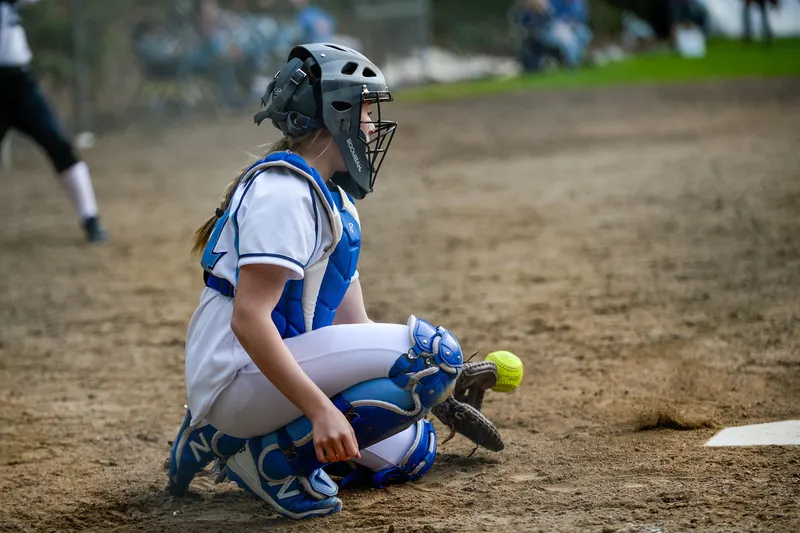
Pop time is the first number a college coach checks on a catcher. It runs from the pitch hitting her glove to the throw reaching the fielder’s glove at second base, so it measures her transfer, footwork and arm together. Here’s what catching recruits show at each level.
- D1 catching recruits usually pop 1.90 or faster; strong ones about 1.70.
- D2 runs about 1.80–2.00, and D3, NAIA and JUCO about 1.90–2.10.
- A clean, quick transfer saves more time than raw arm strength.
On this page
Pop time by level
Lower is better for pop time; higher is better for arm velocity. Each range runs from where a typical recruit at that level starts to a strong recruit.
| D1 | D2 | D3 / NAIA / JUCO | |
|---|---|---|---|
| Pop time, seconds | 1.70–1.90 | 1.80–2.00 | 1.90–2.10 |
| Catcher arm velocity, mph | 61–67 | 57–62 | 54–59 |
Pop time and arm strength ranges line up with published college softball recruiting guidelines (see where the ranges come from). In our evaluation, a catcher’s pop time (or her arm velocity, if no pop time is entered) has to be inside a level’s range for that level to count as a fit. With neither entered, no level shows as a fit yet, and the report names pop time as the missing number.
For grades, rules and every number at one level, see the D1, D2, D3, NAIA and JUCO requirements.
How pop time is measured
- Start the clock when the pitch hits the catcher’s glove.
- Stop it when the throw reaches the fielder’s glove at second base, about 85 feet away on a 60-foot diamond.
- Showcases and catching camps use the same start and stop. At home, a slow-motion video gives the most accurate reading.
- Report her best and her average from a session. Coaches trust a repeatable time.
What goes into a fast pop time
- Exchange: glove to throwing hand in one motion. This is where most catchers lose time.
- Footwork: short, quick steps toward second without drifting.
- Arm: catcher arm velocity, measured on a throw to second.
- Accuracy: a throw on the bag is worth more than a tenth of a second off line.
How to lower pop time
- Exchange drill: 3 sets of 15 quick glove-to-hand transfers.
- Footwork-only reps: 3 sets of 10, focusing on speed and balance.
- Timed throws to second: film and time glove to glove, and track her best and average.
Receiving, framing and blocking matter just as much. Coaches judge those on video, so film them too. See how to make a softball recruiting video.
Common questions
What is a good pop time for a high school softball catcher?
What pop time do D1 softball catchers need?
Is a 2.0 pop time good in softball?
How do you measure pop time in softball?
More recruiting guides
Home to First Times for College Softball RecruitsCollege Softball Recruiting Standards by PositionHow to Make a Softball Recruiting VideoRanges are Softball Future recruiting targets, checked November 2026. They are planning targets, not NCAA standards. Players get recruited above and below them. Where each range comes from.