D2 vs D3 Softball (and NAIA vs JUCO)
Updated November 2026
D2 or D3? NAIA or junior college? In softball these levels sit closer together than most families think, and the right one depends on her numbers, her grades and what your family can pay. Here they are side by side, using the same rules and ranges as our level guides.
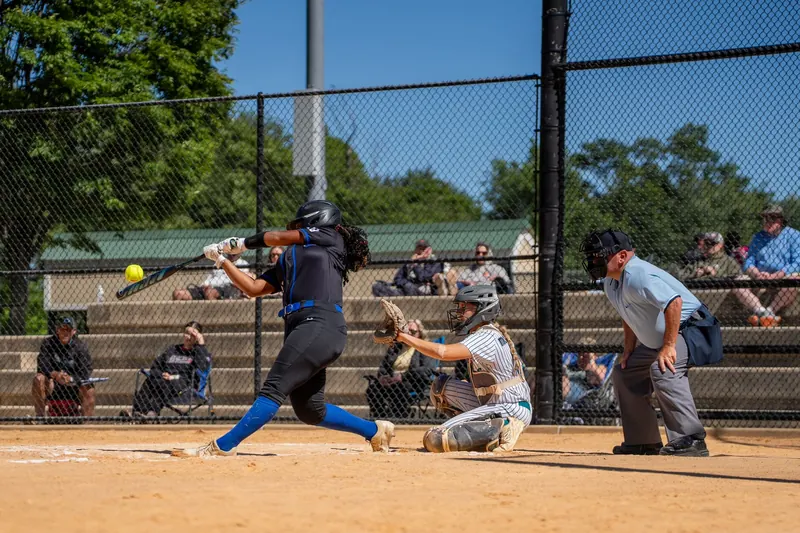
- D2 programs can award up to 7.2 softball scholarships, split across the roster. D3 gives no athletic aid, but academic and need-based aid often closes the gap.
- D2 pitching recruits usually peak at 58+ mph from 43 feet; D3 pitchers start around 55. D2 hitters usually show 2 or 3 mph more exit velocity.
- NAIA is a four-year level with up to 10 scholarships and numbers close to D3. JUCO is two years: play right away, then transfer.
On this page
All five levels at a glance
| Level | Athletic scholarships | Academic rule | Coaches can start contact |
|---|---|---|---|
| D1 | No fixed cap; 25-player roster limit at settlement schools (12 at others) | 2.3 core GPA, 16 core courses | Sept. 1 of junior year |
| D2 | Up to 7.2 per team | 2.2 core GPA, 16 core courses | Calls and texts anytime; in person from June 15 before junior year |
| D3 | None; academic and need-based aid | Each school’s admission | In person after sophomore year |
| NAIA | Up to 10 per team | 2.3 GPA, or two of three standards | Few limits on timing |
| JUCO | Up to 24 at NJCAA Division I programs; varies | High school graduate, full-time enrollment | Earlier than D1; ask each program |
| Level | Peak pitch speed | SS/2B peak exit velo | SS/2B home to first (right-handed) |
|---|---|---|---|
| D1 | 63–68 mph | 68–76 mph | 2.75–3.00 |
| D2 | 58–62 mph | 62–69 mph | 2.85–3.10 |
| NAIA | 56–61 mph | 60–67 mph | 3.05–3.30 |
| D3 | 55–60 mph | 60–67 mph | 3.00–3.25 |
| JUCO | 54–61 mph | 60–67 mph | 3.05–3.30 |
Pitch speeds are from 43 feet. Home to first is from a full swing; slappers run faster. Every position is on recruiting standards by position.
D2 vs D3 softball
- Money: a D2 program has up to 7.2 scholarships to share, so most D2 players get part of one. A D3 school gives nothing for softball, yet its academic and need-based package can leave a family paying less than a partial D2 offer.
- Level of play: D2 pitchers usually throw 2 to 3 mph harder, and D2 hitters hit the ball a little harder. A pitcher at 58 to 60 mph fits both; one at 55 to 57 fits D3 more often.
- How many schools: 274 D2 and 396 D3 programs sponsor softball in 2026-27. D3 is the largest NCAA division, so it usually has more options within driving distance.
- Academics: D2 runs through the NCAA Eligibility Center (16 core courses, 2.2 core GPA). Each D3 school sets its own admission standards.
- Recruiting contact: D2 coaches can call, text and email at any time and meet her off campus from June 15 before junior year. D3 coaches can meet in person off campus after sophomore year.
How hard is it to play D3 softball?
It’s real college softball. About 2.5% of high school players reach Division III, the same share as Division II, according to NCAA research. D3 pitching recruits usually peak at 55 to 60 mph, and D3 middle infielders hit 60 to 67 mph at their peak. Top D3 programs regularly land players who also had D2 offers.
What level is NAIA softball?
The NAIA is its own association of four-year schools, separate from the NCAA. In Softball Future’s ranges, NAIA recruits look a lot like D3 recruits, with pitchers a touch faster. The difference is aid: NAIA programs can give up to 10 softball scholarships, and NAIA coaches can contact recruits with few limits on timing.
NAIA vs JUCO softball
- Length: NAIA schools are four-year colleges. Junior colleges are two-year schools, mostly in the NJCAA and, in California, the CCCAA.
- Numbers: the two ranges overlap. JUCO rosters also include players with D1 or D2 tools who need time for grades, strength or development.
- Cost: two-year tuition is often lower, and NJCAA Division I programs can give up to 24 scholarships. NAIA programs can give up to 10.
- Next step: many JUCO players move to a four-year program after one or two years. NAIA players usually stay four years.
How many college softball teams are there?
For 2026-27 the NCAA lists 308 Division I, 274 Division II and 396 Division III softball programs, close to 980 in all. NAIA and junior college programs add hundreds more programs.
Which level fits her?
Start with the number coaches check first at her position: pitch speed for pitchers, pop time for catchers, arm strength for infielders and outfielders, exit velocity for first base. Then look at grades, then budget. When she sits between two levels, keep both on the list. The free evaluation scores her for all five levels at once.
Common questions
Is D2 better than D3 softball?
Do D2 softball players get full rides?
Can D3 softball players get recruited?
Is NAIA better than JUCO for softball?
How many D1 softball teams are there?
How many D2 and D3 softball teams are there?
More recruiting guides
D2 Softball Recruiting RequirementsD3 Softball Recruiting RequirementsNAIA Softball RecruitingJUCO Softball RecruitingCollege Softball Scholarships by LevelAll recruiting guidesOfficial rules come from the NCAA, NAIA and NJCAA pages linked from our level guides, checked October 30, 2026. Rules change, so confirm with each school. Ranges are Softball Future estimates for planning, not NCAA standards; players are recruited above and below them. Softball Future is not affiliated with the NCAA, NAIA, NJCAA or CCCAA. Where each range comes from.