Average Softball Pitching Speed by Age, Plus Exit Velocity and Speed
Updated November 2026
College coaches compare a player with others her age, not with seniors. These tables show the pitch speed, exit velocity and home-to-first time that keep a player on pace for each college level at ages 14 to 17. They start from the ranges our level guides use for recruits finishing high school and work back with the growth credit the Softball Future evaluation gives: three quarters of a typical year’s gain for each year left before the end of high school.
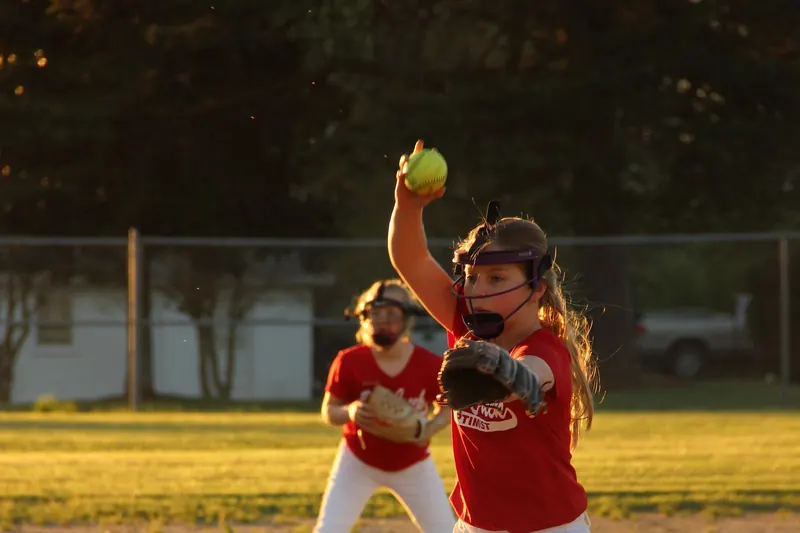
- A pitcher on pace for D1 peaks around 60 mph at 15 and 62 mph at 16, from 43 feet. D2 pace is about 5 mph less.
- A middle infielder on pace for D1 hits about 64 mph at her peak at 15 and 66 mph at 16.
- Typical gains per year in high school: about 1.5 mph of pitch speed, 2.5 mph of exit velocity and 0.03 seconds off home to first.
On this page
How to read these tables
- Each number is where a level’s typical recruit starts, pulled back to that age. At or above it, she’s on pace for that level today.
- These are on-pace marks for college recruits, not averages for every player her age. Most players her age throw and hit below them.
- Ages are on testing day, at the middle of that year of age (a 15-year-old is treated as 15½).
- Players develop at different speeds. A pitcher below pace at 15 can be well inside a range by 18.
- These are Softball Future planning estimates, not NCAA standards. Exit velocity and home to first are for shortstops and second basemen; other positions shift a little, see standards by position.
Softball pitching speed by age
| Age | D1 | D2 | NAIA | D3 | JUCO |
|---|---|---|---|---|---|
| 14 | 59 mph | 54 mph | 52 mph | 51 mph | 50 mph |
| 15 | 60 mph | 55 mph | 53 mph | 52 mph | 51 mph |
| 16 | 62 mph | 57 mph | 55 mph | 54 mph | 53 mph |
| 17 | 63 mph | 58 mph | 56 mph | 55 mph | 54 mph |
| End of high school | 63 mph | 58 mph | 56 mph | 55 mph | 54 mph |
Average pitch speed usually runs about 2 mph below peak. A changeup about 9 to 13 mph slower than the fastball matters as much as raw speed. More detail in the pitching speed guide, and see what else coaches evaluate in the recruiting standards for pitchers. Speeds are from 43 feet, the high school and college pitching distance.
Exit velocity by age
| Age | D1 | D2 | D3 / NAIA / JUCO |
|---|---|---|---|
| 14 | 62 mph | 56 mph | 54 mph |
| 15 | 64 mph | 58 mph | 56 mph |
| 16 | 66 mph | 60 mph | 58 mph |
| 17 | 68 mph | 62 mph | 60 mph |
| End of high school | 68 mph | 62 mph | 60 mph |
First and third base players usually need about 2 to 3 mph more, catchers and outfielders about 1 to 2 mph more. Slappers are judged more on speed; see the standards for slappers. More detail in the exit velocity guide.
Home to first times by age
| Age | D1 | D2 | D3 | NAIA / JUCO |
|---|---|---|---|---|
| 14 | 3.07 | 3.17 | 3.32 | 3.37 |
| 15 | 3.05 | 3.15 | 3.30 | 3.35 |
| 16 | 3.03 | 3.13 | 3.28 | 3.33 |
| 17 | 3.01 | 3.11 | 3.26 | 3.31 |
| End of high school | 3.00 | 3.10 | 3.25 | 3.30 |
Outfielders run about the same or slightly faster, and corner infielders and catchers about a tenth slower. Slap times are much faster and aren’t comparable. More detail in the home to first guide.
Measure the trend, not one day
One reading tells you where she is. Three readings a few months apart show where she’s heading, and that’s what a coach wants to see from a younger player. A home radar makes that cheap.
Pro radar guns and pitch-tracking units often cost $1,000 or more, and a showcase gives you a reading only a few times a year. A Pocket Radar is accurate to 1 mph and fits in a bat bag, so you can clock every bullpen, practice and tee session, track progress week to week and show coaches a trend instead of one number.
- Clocks pitches, throws and exit velocity
- Accurate to 1 mph, from 25 to 130 mph
- Simple and pocket-sized, no phone or app needed
- Everything the Ball Coach does, just as accurate
- Pairs with the Pocket Radar app to show and save every reading
- Records video with the speed on screen, ready to send to coaches
We earn a commission if you buy through these links, at no extra cost to you.
How to stay on pace
- Build leg and hip strength. It drives pitch speed, exit velocity and speed out of the box.
- For pitchers, track pitch counts across school, club and lessons, and plan rest each year.
- Measure on the same device each time so the trend is real.
- Work first on the number furthest below pace. That usually moves her up a level fastest.
To see whether her numbers are on pace for her age, start a free player evaluation.
Common questions
How fast should a 14-year-old softball pitcher throw?
How fast should a 15-year-old softball pitcher throw?
How fast should a 16-year-old softball pitcher throw?
What is a good exit velocity for a 15-year-old softball player?
What is a good home to first time for a 16-year-old?
How much pitching speed does a softball pitcher gain each year?
More recruiting guides
How Fast Do You Need to Pitch to Play College Softball?What Exit Velocity Do You Need to Play College Softball?Home to First Times for College Softball RecruitsCollege Softball Recruiting Timeline by GradeAll recruiting guidesOfficial rules come from the NCAA, NAIA and NJCAA pages linked from our level guides, checked October 30, 2026. Rules change, so confirm with each school. Ranges are Softball Future estimates for planning, not NCAA standards; players are recruited above and below them. Softball Future is not affiliated with the NCAA, NAIA, NJCAA or CCCAA. Where each range comes from.